

Welcome to the front porch of Sideways Into Crazy. (Just picture that welcome mat under your feet!) Today is the official kickoff of my Substack, and my renewed creative practice. As I continue to understand how to build an identity as an artist, I’m working a self-designed residency in story, life, and alchemy here in Asheville, N.C.
If you’ve fried your soul trying to do the right thing, maybe you can identify. This story is about the exact moment my old identity began to crack.
I first published a version of this on Medium, in 2020.
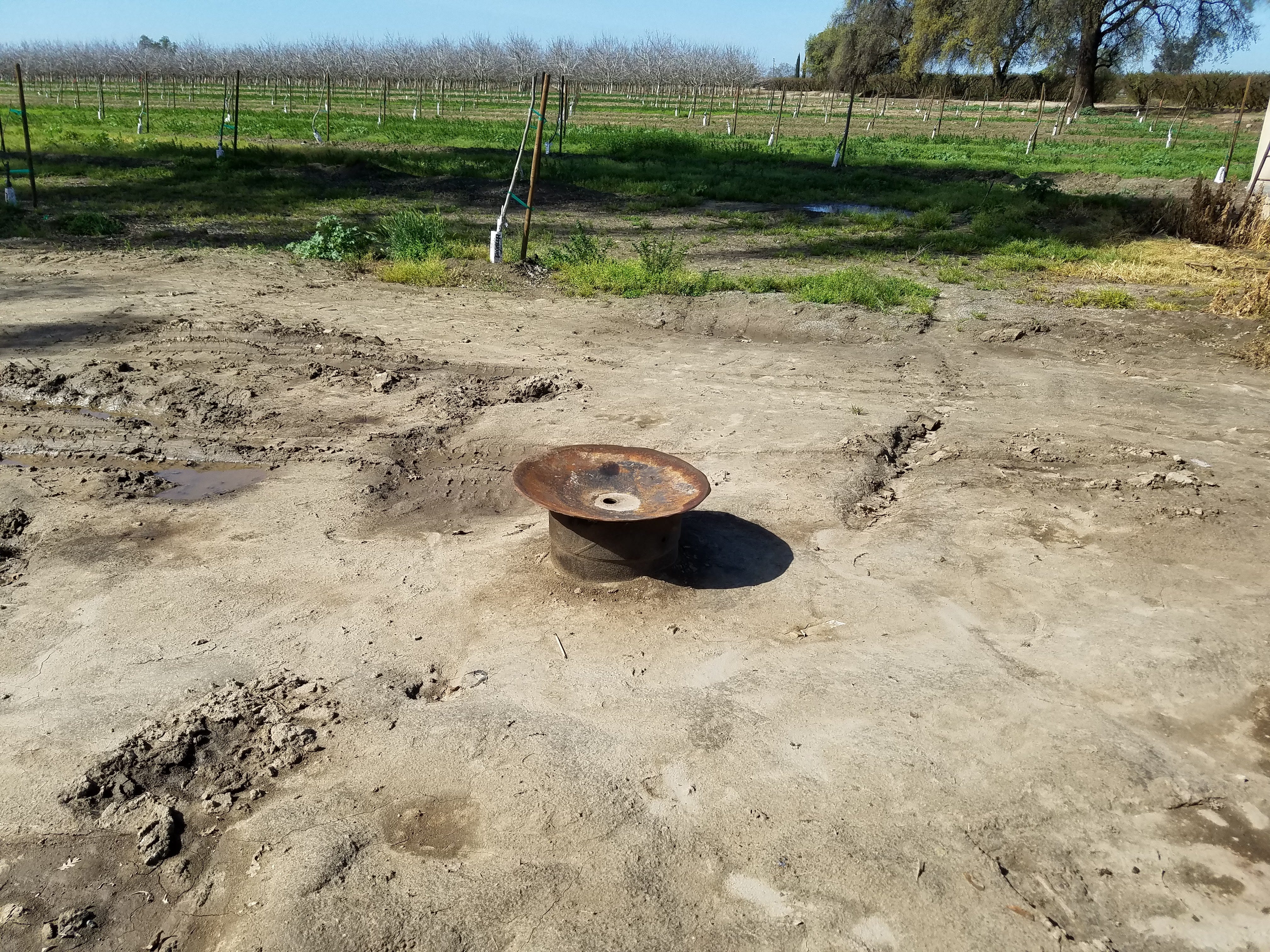
Fieldwork photo from the author’s archive: flood irrigation fixtures in a Central Valley field.
Our office door’s cheery jingle draws me from my dark desk-cave. Despite a deep overhang and tinted windows, the reflected sun-furnace outside bakes the lobby.
It is July 2013. High noon in Central Valley, California.
It is already 105 F and will climb at least another five degrees on this nuclear day. California is two years into a seven-year drought and I am working at ground zero.
Joe has jingled through the door. A leathery-faced guy in his 60’s, Joe wears farmer’s armor: a light long-sleeved button shirt, jeans, and worn leather boots. With a sigh, he plops his straw hat on the imitation wood-grain table and sits back to soak up the A/C. I pull his file and our talk turns (of course) to the drought.
Joe’s neighbor recently drilled a new well, replacing his old dried up well. Over two-hundred thousand dollars later and seven hundred feet down, his neighbor has a reliable source of water.
For now.
The water comes from somewhere…
I have heard this same story twice already this week. Wells are drying up, surface water is shut off, trees are dying. Before the snows return to the Central Sierras four years from now, several small communities will truck in their drinking water.
Farmers and cities are squaring off, pointing fingers over water use. No one knows the answer but a piece of the puzzle is conservation.
Today, Joe has come in to sign for a grant. Our agency funds micro-irrigation systems. I see it as a way to help farmers save water. Joe sees it as a way to stretch his irrigation water and expand his production.
Suddenly, the win-win is pivots into conflict: our agency is funding conservation, not the expansion of production. Before Joe can get any money, he has to submit a new design that stays within his current crop footprint.
Joe shakes his head at me and says, “You know what? We just need to pipe water from the Columbia River, up there in Washington State.”
I laugh. As a Washington-born Conservation Ecologist and Hydrologist, I can’t even take the comment seriously.
Joe says, “No, I’m serious. Can you believe it? They just let all that water run down the river into the ocean! What a waste.”
Because I like Joe, I pause, take a deep breath, and proceed to gently educate him. His eyes take five minutes to cross. My (professional) rant includes water rights, endangered species, shipping, and NOT TO MENTION IT’S WASHINGTON’s EFFING WATER!!
After Joe leaves (chastened but not changed), I slam the file cabinet drawers, and in my best fifth-grade whine… “all that water just running to the ocean!”
I cast my arms to our water-stained ceiling and dramatically plead to any listening conservation gods; “What else is it supposed to do??!!”
My co-workers barely look away from their screens. I get a couple of head shakes, a chuckle, a shrug.
Tough room.
Paved with good intentions.
My drive home that evening is a special little hell. Sweat pours down my back, my 1992 Accord with broken AC overheating me and my iPhone. Two science degrees, countless hours of agency training, and it’s all useless.
Questions tumble through my mind: How do I reach people? How do I get them to stop wasting water?
The even bigger question:
How do I make a difference?
As a co-worker told me;
“Conservation in the Central Valley isn’t conservation, it’s a funding assembly line. Our job isn’t getting conservation on the ground, it’s screwing on lugnuts, getting the money out.”
Tears join sweat trailing down my cheeks and my gut twists.
The work I am doing is part of the problem.
Just the facts, ma’am
When I took up my hero’s cape and jumped into environmental conservation, I thought all the farmers in the Central Valley just needed some education.
I thought surely if people just had the facts, they would break into Sondheim-like celebration as they greened the Earth.
Instead, they hold out their hand and increase their footprint. They want to keep going the way they have so they look for more water, drill deeper, scrape the topsoil, and continue flood irrigating.
Farmers like Joe grudgingly make incremental changes, but despite all the facts I give them, if we stopped paying them, the changes would be gone.
As it turns out, pounding facts into people’s heads, (while satisfying,) doesn’t work. Behavioral economists like Julia Dhar recommend a “shared reality” instead.
We share our reality with stories.
Several weeks later, I stand in a misty field, lured outdoors by the cool fall weather. Will is a dairy farmer. My lecture on over-watering and fertilizing is chambered and ready to fire, but Will says something that stops me in my tracks:
“I used to think the irrigation water was ours, you know? I resented all those Northern California farmers who didn’t want to send the water south to us. Then we had coffee together, and you know what? They thought the water was theirs. After all, it fell to the ground near them. And you know what? They have a point! So I want to do the right thing, and try to work with the water we have.”
After picking my jaw up off the ground, I pivot and we talk conservation. Fertilizer plans, pollinator habitat, the works… Just like that — I become a helpful technician rather than a lecturer.
Stories did my job for me.
Will had experienced that “shared reality” with those farmers when he joined them for morning coffee, and it created a big change in him. He asked questions, answered them, went to church with them, walked in their fields, and looked at their irrigation methods.
We are emotional, social critters. We may think we are rational, that we treasure science, but without a story, science is … well… impractical and boring.
Even the agency I worked for was founded in the sense of the dramatic. Hugh Hammond Bennet, the founder of the Soil Conservation Service during the dustbowl, timed his testimony before a Congressional committee to coincide with a huge dust storm that hit Washington D.C.
He knew it was coming, and let it tell the story.
Science informs us what needs to happen BUT story and connection are what make us care. THAT powers change.
Telling stories is tough. It requires vulnerability.
I had to step out of the intellectual “know-it-all” persona into an unpredictable, messy arena.
I focused a less on technical information and asked questions. I wrote newsletter articles, listened to family histories, and even found myself on stage as a “waterdrop” at the local fair.
My growing love of stories opened doors for me: a few of my farmers moved beyond money for irrigation into mulching and cover crops. In the very practical culture of Central Valley farming, this was huge progress. It lead me a whole new direction, and into my love of storytelling. (more on that to come!)
An Unlearning Prompt
Observation: Think of a story a friend, coworker, or family member shared with you recently where you immediately wanted to jump in and solve the problem with facts or figure out “who was right and who was wrong.”
Action: Take a breath and let go of the need for a moral or a solution. Find a moment to just let yourself be inside a story, and look for a connection instead. Want to make a difference? Listen to a story. Tell a story.